.svg)





 العربية
 English

المطبخ الذي يُشعرك بالراحة: كيف يؤثر التصميم فعلياً على مزاجك
- January 18, 2026
- /
- أدلة المشتري والبائع
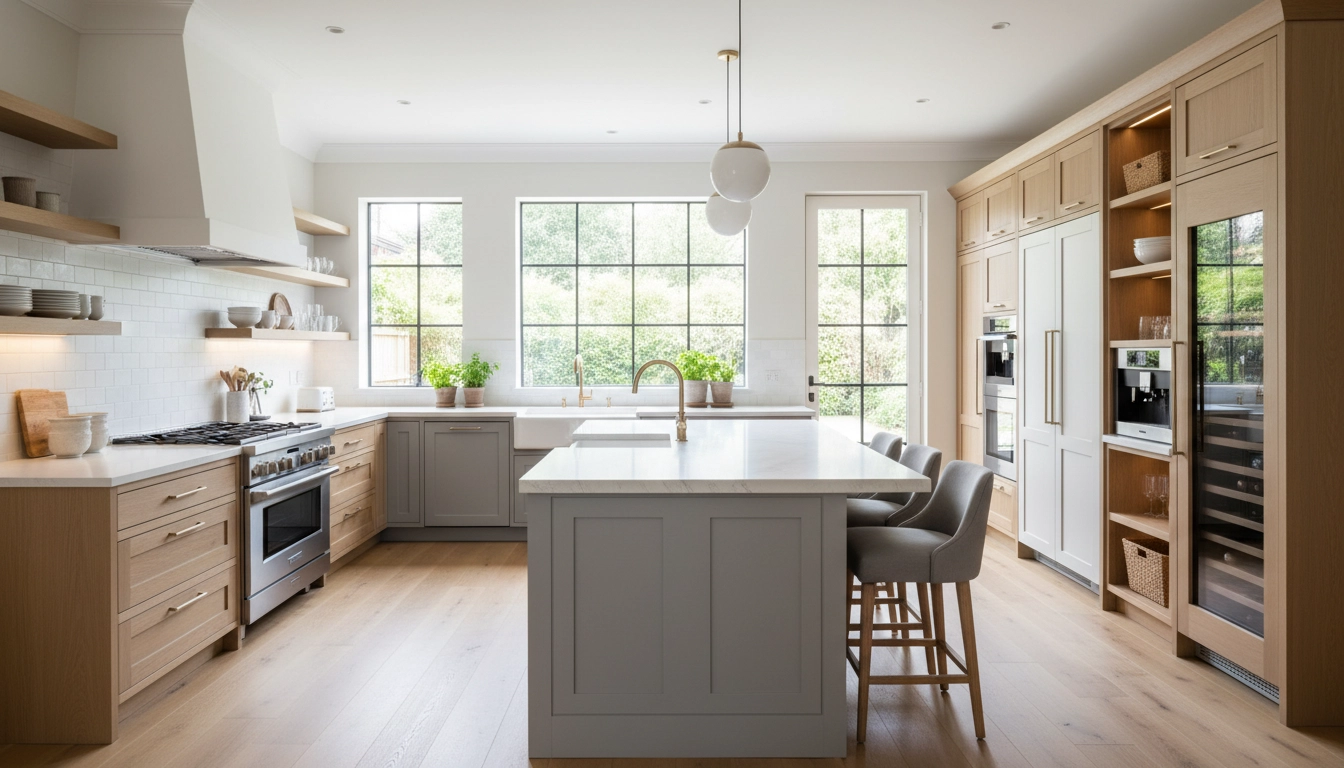
When people talk about “well-being at home”, they usually jump to:
Bedroom comfort
Balcony view
Living room vibe
The kitchen?
It’s often reduced to: “Is it open or closed, marble or not?”
But a big review of kitchen research and positive psychology basically says this:
Your kitchen is not just where the fridge lives. It’s one of the main emotional engines of your home.
And the fun part?
We can actually explain it.
A group of researchers looked at more than a thousand studies on kitchens, homes and happiness, using the PERMA model from positive psychology:
P – Positive Emotion
E – Engagement
R – Relationships
M – Meaning
A – Accomplishment
Let’s take that model and walk through what it means for real kitchens in real homes.
1. P is for Positive Emotion: Does Your Kitchen Feel Nice?
Forget design jargon for a second and ask:
“Do I actually like being in this room?”
Small things make a big difference:
Light
Natural light in the morning, warm light in the evening – this changes the whole mood. A bright, airy kitchen feels like “Let’s make breakfast.” A dark cave feels like “Let’s order in.”Air & temperature
A good extractor, a window you can open, not melting in front of the stove… all of that decides whether cooking is mildly relaxing or slowly turns into suffering.Noise & clutter
Constant noise + messy counters = low-level stress.
A bit of order + some quiet = your shoulders drop down a notch.
In a compact apartment, you might not be able to build a giant show kitchen, but you can still ask when you’re viewing a unit:
Does this kitchen get any daylight at all?
Is there real ventilation or will every meal smell like you deep-fried the walls?
Is there enough storage to keep most things off the counters?
If the answer is “no” three times in a row, that’s not just a design issue. It’s a mood issue.
2. E is for Engagement: Can You Actually Get “In the Zone” Here?
Engagement is that feeling when you’re absorbed in what you’re doing.
In the kitchen, that’s the difference between:
“This is kind of fun.”
vs“Where do I put this? Why is everything in the way?”
Kitchens that support engagement usually have:
Logical flow
Fridge → sink → prep space → stove.
If you’re walking in circles just to make pasta, the layout is fighting you.Enough counter space
Not fantasy Pinterest island levels of space – just enough room to chop, mix and plate without balancing everything on top of the microwave.Smart storage
Everyday tools close at hand, not buried behind three slow cookers you never use.
Smart appliances can help if they simplify things (clear controls, safe, reliable). If you need a manual and a YouTube tutorial just to boil water, your kitchen is not helping your brain get into “flow”.
When the layout works, cooking becomes a small creative break in your day.
When it doesn’t, it’s just another task you’re trying to escape.
3. R is for Relationships: Who Do You Share This Space With?
Let’s be honest: a lot of the best conversations at home happen near food.
The research is very clear on this part:
Families that cook and eat together more often tend to report better connection and communication.
Kitchens that allow people to see and talk to each other make that much easier.
Design details that help:
A counter or island facing the living/dining area, not a blank wall.
Enough space for two people to move without bumping into each other every 30 seconds.
A small spot to sit or lean – a stool, a bench, a bit of built-in seating.
Ask yourself when you look at a floor plan or walk into a kitchen:
Can someone cook while still chatting with family or friends?
Is there a place for kids to do homework or hang around without being in the way?
Or is this clearly a “one person, back turned, door closed” room?
If the kitchen isolates the person who cooks from everyone else, it’s not just inconvenient. It’s a missed opportunity for daily micro-connection.
4. M is for Meaning: Does This Kitchen Fit Your Story?
Meaning is about feeling that what you do connects to something bigger than just “getting things done.”
In the kitchen, that can mean:
Culture & tradition
Family recipes, weekend breakfasts, holiday meals, special dishes for celebrations. The kitchen is where a lot of identity and culture lives.Values
Maybe you care about cooking more at home, wasting less food, eating together, or teaching kids basic cooking skills. The kitchen is the place where those values become real life.
Design can support this by:
Making room for the tools you actually use (big pots, tajine, wok, espresso machine, whatever “your thing” is).
Allowing some form of shared eating – even if it’s just a small table or built-in corner.
Giving you places to store food in a way that matches how you shop (bulk vs daily, fresh vs frozen, etc.).
A kitchen that looks fancy but doesn’t fit your culture, cooking style or routines will always feel a little fake.
A simpler kitchen that really supports your way of living will feel much more meaningful.
5. A is for Accomplishment: Does This Kitchen Make You Feel Capable?
Accomplishment here is not about Michelin stars.
It’s about small daily wins:
“I pulled off dinner on a busy day.”
“I finally tried that recipe and it worked.”
“I can host two friends without panicking.”
Kitchens that boost this feeling tend to:
Make it easy to organise things so you know where everything is.
Have enough space and safety to try new recipes without chaos.
Give you visual signals of progress – clean counters, tools in place, meals that look good enough to be proud of.
Kitchens that crush accomplishment do the opposite:
No space to work, so every meal feels like a fight.
Constant feeling of “I’m bad at this” when in reality the space is badly designed.
You end up ordering in more, not because you want to, but because cooking in that room drains you.
Over time, that shapes both your habits and how you see yourself at home.
6. What This Means When You’re Choosing a Home
You can’t ask a listing:
“Excuse me, how’s your PERMA?”
But you can use this model quietly in your head when you walk into a kitchen.
Try this checklist:
Positive Emotion
How does this room make me feel in the first 10 seconds? Heavy or light?
Light, air, smell, noise – do I naturally want to stay or step back?
Engagement
Can I imagine cooking one full meal here without swearing at the layout?
Is there at least one clear, usable work surface?
Relationships
Can I see and talk to people while cooking?
Is there any way to be together here – even in a small way?
Meaning
Does this kitchen have space for how we cook and eat, not just what looks good on Instagram?
Can I picture our real life happening here?
Accomplishment
Does this room make me feel “Yes, I can handle this”, or “This will exhaust me”?
With a bit of organising, would I feel proud to invite someone into this space?
You don’t need a perfect score on all five.
But if a kitchen fails on almost every point, no amount of marble will fix that in the long run.
Final Thought: Kitchen as the Emotional Hub
Under all the design trends, the message is simple:
A good kitchen is not just the one that photographs well.
It’s the one that quietly:
lifts your mood,
supports your routines,
brings people together,
fits your story,
and helps you feel a little more capable every day.
So next time you look at a floor plan or step into a show unit, don’t just ask:
“Is this kitchen nice?”
Ask:
“Can this kitchen make our life here feel better?”
That’s where the real value is hiding.
